Tracking response rates
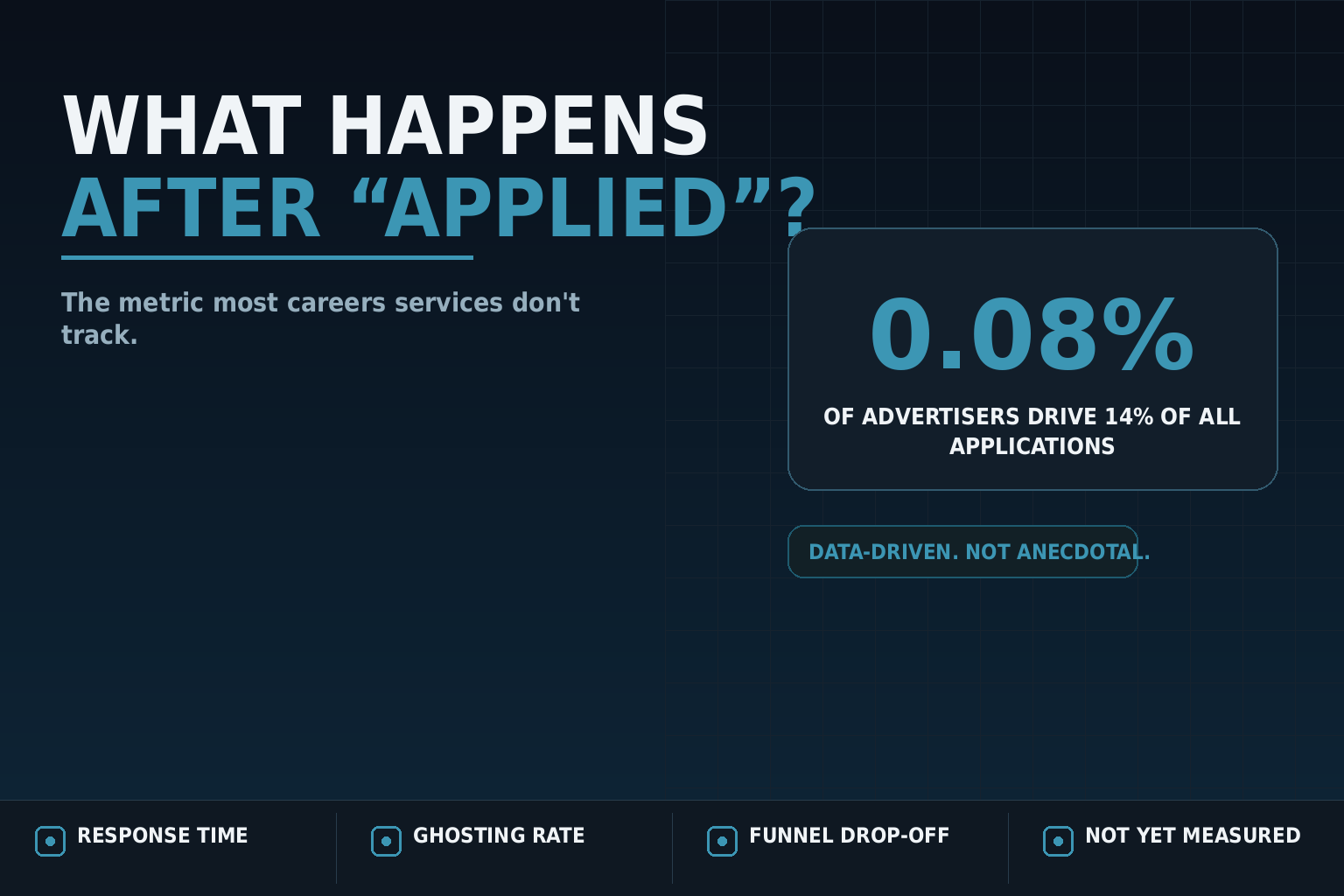
The metric no careers service tracks: what happens after "Applied"
What happens after the application?
Most careers services don't know.
Why this gap matters
A student who applies to ten roles through a partner and hears nothing back from any of them will draw conclusions — about their own employability, about the partner, about the process — that may have nothing to do with their actual candidacy. If that partner has a structurally low response rate across all candidates, the student is absorbing a systemic problem as a personal one. Your office is well positioned to catch that distinction, but only if you're tracking response behaviour at the partner level.
⏱️ Time-to-first-response
By partner, aggregated across your cohort over a term.
👻 Ghosting rate
Proportion of applications receiving no status update within, say, three weeks.
🔀 Funnel conversion
Applied → response → interview → outcome, by partner, to see where students drop out.
🎯 Use this constructively
Most response gaps come from mundane causes — understaffed teams, high application volume, seasonal pauses — not bad faith. Going to a partner with "our students report an average six-week silence" is a far stronger basis for a productive conversation than an anecdote, and protects the relationship rather than damaging it.
Track what happens after "Applied"
GetJobzi tracks advertiser-level response and outcome data — institutional partners get aggregate access for their own student cohorts.
👉 GetJobzi.com — Talk to us